
+201001744007 [email protected]

… Affirms that the restoration and reinstallation of King Amenhotep III’s statues aim to preserve and revive one of the most important landmarks of the ancient Egyptian civilization.
… Extends thanks and appreciation to all workers on the project, praising their exceptional efforts, precision, dedication, and devotion in completing this honorable work.
… Honors Dr. Hourig Sourouzian in appreciation of her continuous efforts and outstanding contribution over the past years in reviving the Mortuary Temple of King Amenhotep III.
The Secretary-General of the Supreme Council of Antiquities confirms that all work on the statues was carried out according to the latest scientific methods and international standards adopted in archaeological restoration, using materials compatible with the nature of the archaeological stone to ensure their long-term sustainability.
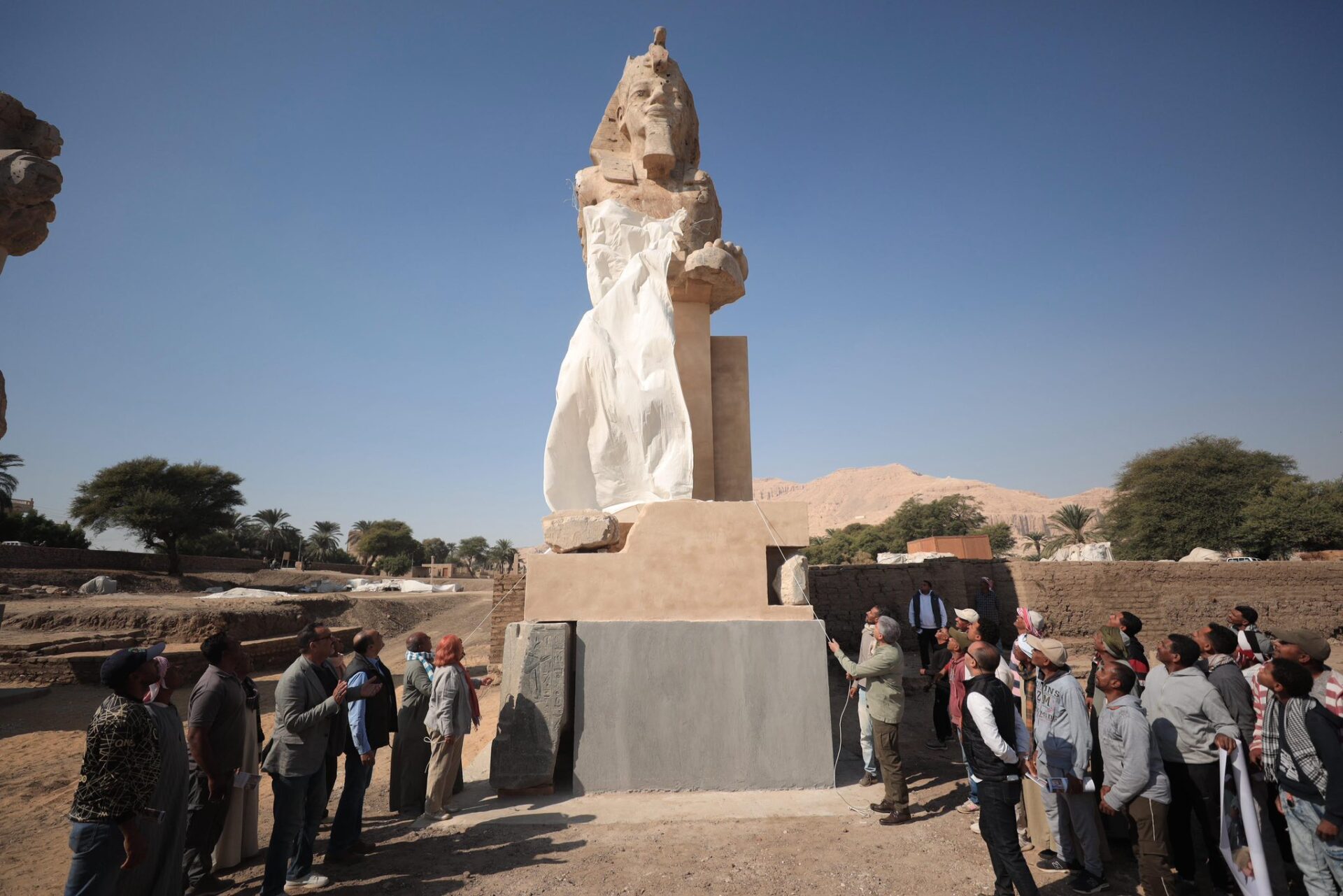
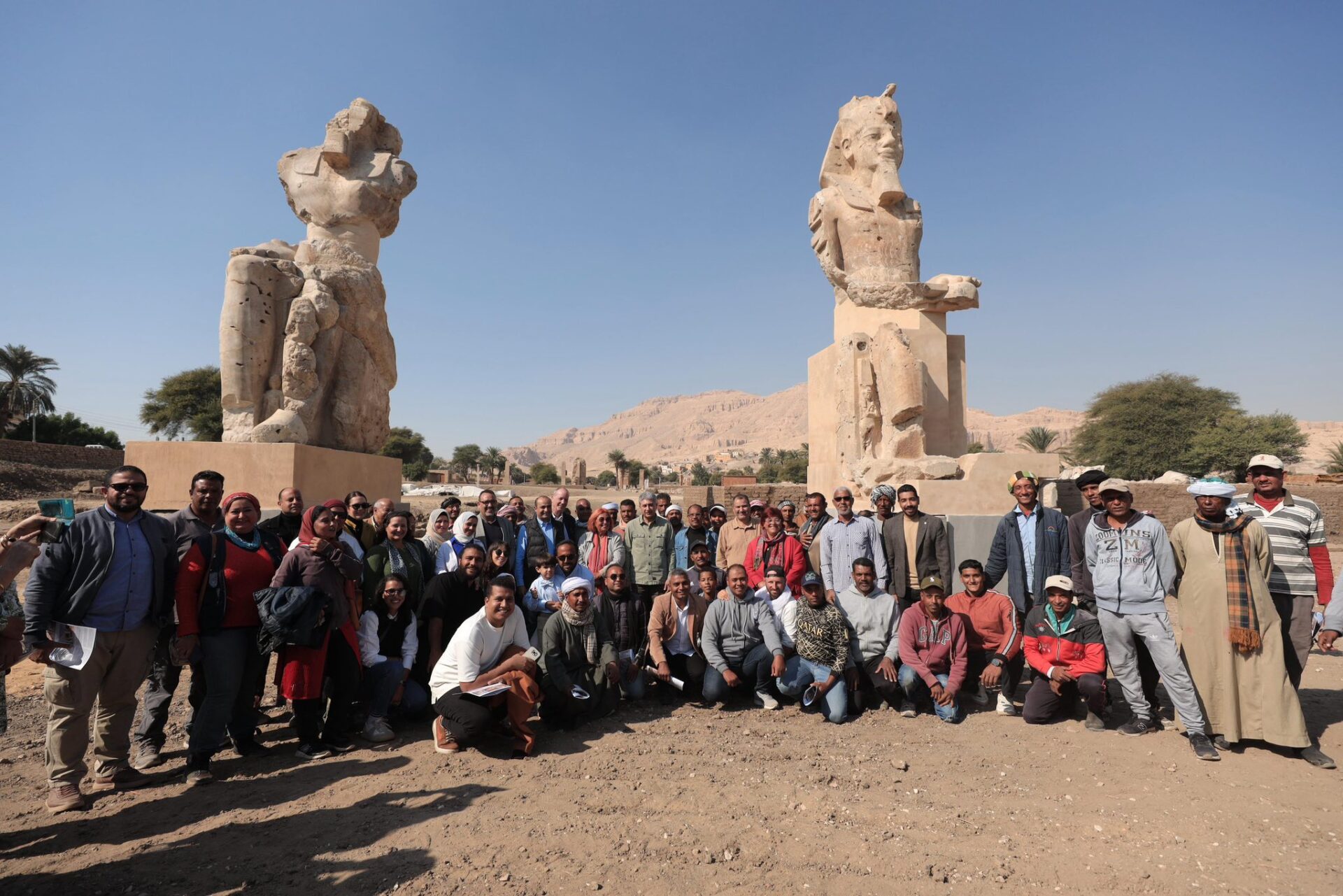
During his visit today to the city of Luxor to inspect a number of archaeological sites, Mr. Sherif Fathy, Minister of Tourism and Antiquities, witnessed the unveiling of two colossal alabaster statues of King Amenhotep III, after they were restored, reassembled, and raised to their original location at the Third Pylon of the King’s Mortuary Temple on the West Bank in Luxor. He was accompanied by Dr. Mohamed Ismail Khaled, Secretary-General of the Supreme Council of Antiquities, and in the presence of Dr. Hisham El-Leithy, Head of the Antiquities Conservation and Registration Sector, Ms. Rana Gawhar, Advisor to the Minister for Foreign Relations and General Supervisor of the General Department of International Organizations for Cultural Heritage and International Cooperation, Mr. Mohamed Abdel Badea, Head of the Egyptian Antiquities Sector, Dr. Bahaa Abdel Gaber, Director General of the West Bank Antiquities Area, Dr. Dietrich Raue, Director of the German Archaeological Institute in Cairo (DAI), Dr. Hourig Sourouzian, Project Director, Dr. Naira Habekian, Site Engineer, and a number of leaders of the Supreme Council of Antiquities in Luxor.
This came within the framework of the project to preserve the Colossi of Memnon and the Mortuary Temple of King Amenhotep III, which began in 1998 in cooperation between the Supreme Council of Antiquities and the German Archaeological Institute in Cairo, which supported the project’s initiative, and the World Monuments Watch and World Monuments Fund programs, which provided the vision for the site preservation project in 1998 and the commencement of its implementation, and the Johannes Gutenberg University in Mainz, with the aim of protecting what remains of the temple and restoring it to its original form as much as possible. The work resulted in the discovery, restoration, documentation, reassembly, and raising of numerous statues that were present in the temple, in addition to some of its architectural elements.
In his speech on this occasion, Mr. Sherif Fathy expressed his happiness with the work he witnessed today, describing it as a great achievement and outstanding work that aims to preserve and revive one of the most important landmarks of the ancient Egyptian civilization, commensurate with its historical value, and contributing to enhancing Luxor’s position as one of the most important tourist and cultural destinations worldwide.
The Minister stressed that the work witnessed today reflects a genuine passion and great commitment from all participants in this project, pointing out that what has been achieved is a tangible and proud accomplishment, embodying the belief of those responsible in their mission and in the greatness and historical depth of the Egyptian civilization.
He also referred to the Egyptian-German cooperation, which spans many years, affirming that it represents a successful model for fruitful international cooperation, and expressed his aspiration for the continuation of this constructive cooperation for many years to come to serve the goals of preserving human heritage.
In conclusion of his speech, the Minister extended his thanks and appreciation to the site workers, praising their exceptional efforts in difficult tasks, noting that their handling of thousands of tons of heavy loads reflects the magnitude of the challenges they faced as if they were lifting vast distances, and affirming his full appreciation for their dedication and devotion in completing this work in an honorable manner.
Mr. Sherif Fathy also honored Dr. Hourig Sourouzian, presenting her with a certificate of appreciation from the Ministry of Tourism and Antiquities, in recognition of her continuous efforts and outstanding contribution over the past years in reviving the Mortuary Temple of King Amenhotep III, in addition to presenting her with a replica of one of the statues of the goddess Sekhmet, the goddess of protection, a large number of whose statues were discovered at the site during her supervision of the project.
For his part, Dr. Mohamed Ismail Khaled explained that the implementation of the restoration, documentation, reassembly, and raising of these two colossal statues, which lasted nearly two decades, was carried out according to the latest scientific methods and international standards adopted in archaeological restoration, ensuring the preservation of their originality and historical value, and their return to their original location inside the Mortuary Temple of King Amenhotep III on the West Bank in Luxor.
He pointed out that the restoration work included accurate scientific studies, comprehensive documentation of the statues’ condition, and the use of materials compatible with the nature of the archaeological stone, ensuring their long-term sustainability, while taking into account the environmental and climatic conditions surrounding the site, describing the work accomplished as an important step within an integrated plan to revive and develop the archaeological sites on the West Bank in Luxor, and enhance the visitor experience, while fully preserving the archaeological and historical value of the site. Documentation and restoration work is currently underway on the First Pylon of the Ramesseum Temple, and studies necessary to determine the conservation status of Queen Nefertari’s tomb are nearing completion for the possibility of reopening it to the public.
During his speech, Dr. Dietrich Raue, Director of the German Archaeological Institute in Cairo, described the project as one of the largest and most important joint archaeological projects, explaining that the project witnessed the implementation of many complex works, in the framework of close and fruitful cooperation, expressing his sincere thanks to the Ministry for its continuous support, which contributed to the project’s inauguration today and the statues standing in their current form.
Dr. Dietrich Raue pointed out that this achievement is the fruit of joint cooperation of an international and local team that included Egyptian and foreign experts, praising the role of the American Research Center for its support of the project to reduce the groundwater level in the area.
He also expressed his hope for the continuation of joint cooperation to accomplish more future projects, congratulating everyone who participated in this work on the success achieved.
Dr. Naira Habekian reviewed the most prominent challenges that faced the project’s work over the past years, which were represented by the continuous change in the groundwater level, rising and falling, which required precise engineering and technical solutions to maintain the stability of the archaeological site.
She pointed out that the project represented a real opportunity to build qualified Egyptian cadres, as more than 30 Egyptian conservators were trained and qualified, in addition to attracting about 10 architectural engineers to work in the field of antiquities, within the framework of effective and complementary partnership between Egyptian and international expertise.
She also praised the cooperation between the Supreme Council of Antiquities and the German Archaeological Institute since 1998 in achieving unprecedented results in terms of both restoration and capacity building, and that what has been achieved at the site is a leading model to be emulated in the fields of joint archaeological work and international cooperation.
Dr. Hourig Sourouzian said that the mission had found parts of these two statues scattered throughout the site over the years of its work on the project, but they were in a poor state of preservation, as they were submerged by silt and salt water. Some granite blocks making up the base of the statues were also recovered from the Open-Air Museum at Karnak Temples.
She added that in 2006, the project team began cleaning and restoring the statues, conducting 3D scanning, and reassembling the scattered blocks that make them up until they were reassembled and raised today in 2025 to their original display location in the temple. The height of these two statues ranges between $13.6$ and $14.5$ meters.
The project team had found scattered parts of these two statues inside the site over the years of the project’s implementation, but they were in a poor state of preservation due to exposure to silt and salt water that covered most of their parts. Also, during the project work, a number of granite blocks making up the statues’ bases were recovered from the Open-Air Museum at Karnak Temples.
Mr. Mohamed Abdel Badea pointed out that the two statues depict King Amenhotep III seated, with his hands resting on his thighs, wearing the “nemes” headdress topped by the Double Crown and the pleated royal kilt, with a ceremonial beard adorning his chin, while his attire is completed by the traditional bull’s tail. The statues are accompanied by a number of statues of queens, led by the Great Royal Wife Tiye, along with statues of Princess Iset and the Queen Mother Mutemwiya. The sides of the throne are decorated with the “Sematawy” scene, symbolizing the unification of Upper and Lower Egypt, with remnants of original colors still visible on some decorative elements.
It is worth noting that the project to preserve the Colossi of Memnon and the Mortuary Temple of King Amenhotep III included many works, most notably the restoration, reassembly, and raising of a pair of seated quartzite statues at the entrance of the Second Pylon, and the raising of two standing royal quartzite statues at the northern gate of the temple enclosure. The rescue of these dismantled artifacts, removing them from the silt and salt water, and returning them to their original locations was made possible by the implementation of a comprehensive groundwater lowering system, which contributed to lowering the ground level by about three meters, allowing for their safe preservation and reassembly.
Also, 280 statues and statue fragments of the lion-headed goddess Sekhmet were found, documented, and restored, and are currently awaiting display in the columned courtyard of the temple. The discovery and rescue of two limestone sphinx statues are also underway for restoration, in addition to the establishment of a comprehensive plan for site management and protection.
The Mortuary Temple of King Amenhotep III, known as the Temple of Millions of Years, was built during the first half of the 14th century BC over 39 years of his reign. It is considered the largest and richest of the mortuary temples in its architectural and furnishing elements. The temple collapsed due to a violent earthquake in 1200 BC, and its remains were later used as a quarry in subsequent eras, before its ruins were affected by floods that gradually covered them with layers of Nile silt over time.
Only the two colossal statues of King Amenhotep III at the entrance of the ruined temple enclosure, known as the Colossi of Memnon, remained standing in their original positions. The rest of the monuments were destroyed, submerged in salt water, surrounded by fire-causing plants, in addition to threats of encroachment and vandalism. In the nineteenth century, a number of antique collectors and art lovers seized many pieces from the temple ruins.
#Ministry of Tourism and Antiquities
#Egypt #Ministry_of_Tourism_and_Antiquities #Supreme_Council_of_Antiquities
#Luxor #Egyptianhistory
 EN
EN  JA
JA